
Frequently Asked Questions
 
Frequently Asked Questions


Accuracy:

Q) What is the accuracy of the CHEMetrics' test kits?


A) The accuracy of CHEMets® test kits (with the exception of Formaldehyde, Glycol, Nitrate and Nitrite CHEMets
®) is ± 1/2 of each color standard increment.


The accuracy of ULR CHEMets®, VACUettes® and Formaldehyde, Glycol, Nitrate and Nitrite CHEMets
® test kits is ± 1 color standard increment.


The accuracy of the Titrets® test kits varies with the analyte concentration because the Titret® ampoules have a non-linear scale.  At twice the minimum concentration for a particular kit range, with the exception of the Carbon Dioxide Titret kit catalog No. K-1910, the accuracy is ± 10% error.  For K-1910, the accuracy is ±30% at twice the minimum concentration.


The accuracy of Vacu-vials® test kits using CHEMetrics-generated calibrations is typically ± 10% at 75% error of full range (FR),
± 20% of full scale, and ± 30% error at CHEMetrics practical detection limit (PDL), the lower limit of the stated test range.  The following are exceptions:


Catalog No.

Analyte

% Error at PDL

% Error at 25% FR

% Error at 75% FR

K-0603

Aluminum

+ 40

+ 30

+ 20

K-4003

Fluoride

+ 30

+ 30

+ 20

K-6903

Nitrate

+ 30

+ 30

+ 30

K-6913

Nitrate 4

+ 30

+ 30

+ 30

K-6923

Nitrate 2

+ 30

+ 30

+ 30

K-6933

Nitrate 3

+ 30

+ 30

+ 30

K-7003

Nitrite

+ 30

+ 30

+ 30

K-7413

Ozone 2

+ 30

N/A

+ 30

K-9203

Sulfate

+ 30

+ 20

+ 15


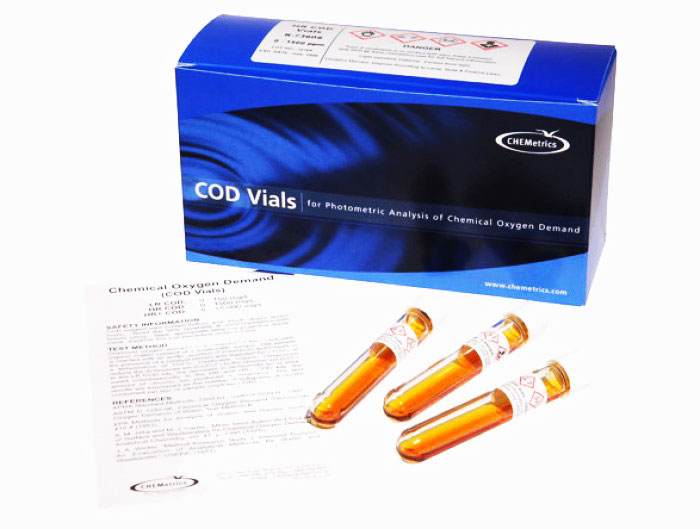
The accuracy of COD Vials test kits is:

Range, ppm

% Error with

Spectrophotometers

% Error with CHEMetrics’ LED

Photometers

0 – 150

+30% @ 10 ppm

+30% @ 20 ppm

+7.5% @ 50 ppm

+15% @ 50 ppm

+5% @ 125 ppm

+7.5% @ 125 ppm

0 – 1,500

+30% @ 30 ppm

+30% @ 100 ppm

+5% @ 500 ppm

+7.5% @ 500 ppm

+5% @ 1,000 ppm

+7.5% @ 1,000 ppm

0 – 15,000

+30% @ 300 ppm

+30% @ 1,000 ppm

+5% @ 5,000 ppm

+7.5% @ 5,000 ppm

+5% @ 10,000 ppm

+7.5% @ 10,000 ppm


For COD NPDES reporting purposes, a spectrophotometer is the preferred method of measurement because LED photometers do not produce equivalent accuracy, precision, an sensitivity. 


CHEMetrics can provide a Certificate of Conformance that certifies the analytical performance of these water analysis products.


Applications:

Q) What parameters do I need to test for in my specific industry?


A) The required testing parameters vary widely within specific industries. However, CHEMetrics has identified the most often tested parameters in several major industries. The information is available through CHEMetrics' Technical Services department. (See Applications.)


Q) Will CHEMetrics develop or customize a test kit for my specific application?


A) New CHEMetrics products often originate directly from customer requests for streamlined testing methods. To be considered for a custom product, the test should be run frequently, or it should be a procedure that is performed widely in the industry. Contact CHEMetrics' Technical Service Department for more information regarding customized kits or chemistries.


COD:


Q) When can I use the mercury free COD test kits? Are the mercury-free reagents EPA approved?


A) The mercury free reagent is designed for use with samples that contain low levels of chloride. If your sample has less than 80 ppm of chloride the mercury free test is applicable. If your sample has more than 80 ppm of chloride the mercury containing test is required. The mercury free reagents are not approved by the EPA for reporting purposes.


Q) I compared my COD test results to (Competitor) and they did not correspond.


A) If comparing product from two vendors, keep in mind that the accuracy of ALL COD vials commercially available is +/- 5%. Therefore, a difference of as much as 10% could result when comparing various product sources. For this reason CHEMetrics highly recommends that comparison data be generated with COD Standard solutions.


Data generated using COD standard solutions are dependable and should remove any bias associated with the comparative analyses of samples. In addition, ALL COD vials, commercially available, can produce varying test results if the instrumentation is not zeroed correctly. It is imperative that when zeroing the instrument, the reagent blank must be from the same manufacturing lot. For example, if running Hach vials and CHEMetrics vials, it would be necessary to run a blank from the CHEMetrics lot and a blank from the Hach lot. The instrument would have to be re-zeroed when switching between lots (or vendors).


Q) Can I use CHEMetrics COD vials in my Hach instrument?


A) Because CHEMetrics and Hach vials are equivalent, any instrument that can accept Hach COD vials can accept CHEMetrics COD vials. Furthermore, CHEMetrics vials may be used with Hach’s factory-programmed COD calibrations. (No endorsement by Hach Company is implied or intended).

Note: LED photometers do not produce accuracy and precision equivalent to that attainable with spectrophotometers. The use of LED instrumentation is not recommended for COD measurements which will be used for NPDES reporting.


Color Match:


Q) The color match between my test ampoule and the color standards is poor. Why?


A) This condition may be influenced by the light source, background color of the sample and/or a chemical interferant. To obtain the best color match, the light source should be fluorescent. The sample background color issue is addressed under the “Sample Color” heading. If a chemical interferant is suspected, see the “Dilutions” heading or contact CHEMetrics' Technical Service department for assistance.


Competition:


Q) How do CHEMetrics products compare to HACH and other traditional style analysis products?


A) Those products typically use similar chemistries but customers who have used both often report that CHEMetrics vacuum sealed liquid reagent ampoules are faster (less mixing and measuring), safer (no exposure to chemicals), and easier to use (less chance of operator error). These three factors add up to an overall savings in time and money.

Conversions:


Q) How does ppm correspond to mg/L?


A) Most CHEMetrics kits report results as ppm, which is equivalent to mg/L for water samples.


Other helpful conversions:

1% = 10,000 ppm
1 ppm = 1000 ppb


Q) How can I express nitrate results as NO3, instead of NO3-N? Phosphate results as PO4-P instead of PO4?


A) To convert nitrate results from NO3-N to NO3, the results must be multiplied by 4.43.


To convert phosphate results from PO4 to PO4-P, the results must be divided by 3.1.

Custom tests:


Q) I routinely test for (your a nalyte) using a method that could be made faster, easier and safer with a self-filling ampoule. Will CHEMetrics develop a custom test kit for me?


A) If you've ever labored through a lab procedure, longing for a time-saving, self-filling ampoule method, call us! Our products often originate directly from customers eager for easier, more efficient ways to perform routine determinations. To be considered for a custom product, the test should be one that you perform frequently, or one that is widely used throughout your industry.


At CHEMetrics we have extensive experience with private-label packaging and service. We're very flexible in working with each customer's special needs, from printing labels to custom packaging with four-color art. For more information on custom products and private labeling, call 1-800-356-3072
and ask for Technical Services. We look forward to building a test that works for you.

Definitions:


Q) What are CHEMets Kits? Vacu-vials Kits? VACUettes Kits? Titrets Kits?


A) All CHEMetrics testing systems are based on the self-filling ampoule--a glass ampoule with liquid reagent vacuum-sealed inside. Sample is automatically drawn into the ampoule and mixed with reagent when the ampoule's tip is broken below the surface of the sample. The four variations of this technology are as follows:

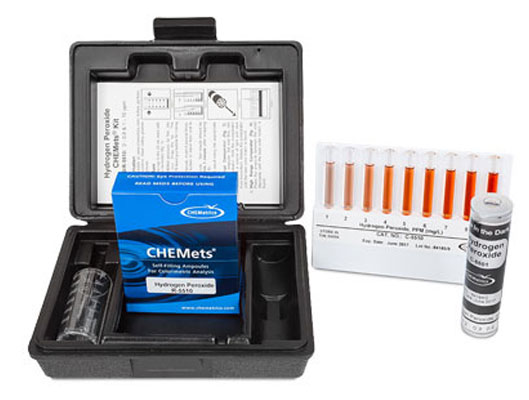
CHEMets Kits - designed for visual analysis of samples with low to medium analyte concentration. Quantitation is performed by visual color comparison with liquid color standards.


Vacu-vials Kits - designed for instrumental analysis of samples. Quantitation is performed photometrically or spectrophotometrically.


VACUettes Kits - designed for visual analysis of samples with high analyte concentration. Auto dilution feature on ampoule tip eliminates the need to perform manual dilutions of concentrated samples. Quantitation is performed by visual color comparison with liquid color standards.


Titrets Kits - designed for titrimetric analysis of samples. A valve assembly attached to the ampoule tip allows the analyst to draw small amounts of sample into the ampoule until a color change indicates the equivalence point of the titration. Quantitation is performed by reading the scale off the graduated ampoule.


Development Time:


Q) How important is the color development time allotment listed in the test procedures?


A) Timing is very important in colorimetric chemistries. Some chemistries will continue to develop color after the specified analysis time.  The most accurate test results will be obtained when the reading is taken in the time presecribed in the instructions.  Visual or instrumental readout after an extended period can give an erroneous result.

Dilutions:


Q) Can I dilute my sample? What can I do if my developed sample color is darker than the darkest color standard?


A) We recommend dilution when a sample is slightly colored or turbid, when interferences are expected or analyte concentration is high.


In most cases, we recommend using distilled or deionised water to perform the dilution. A 1:1 dilution (1 part sample to 1 part distilled/deionised water) will double the range of your test kit. Higher dilutions can also be performed. Be sure to multiply your results to compensate for the dilution. For example, with a 1:2 dilution it would be necessary to multiply the result by 3.


Disposal:


Q) How do I dispose of used reagent ampoules?


A) CHEMetrics provides Material Safety Data Sheets (MSDS) with all test kits which clearly list the chemical components of the solutions and reagents in the test kits. The operator must comply with local, state, and federal regulations for waste disposal. Contact your local regulatory agency or waste disposal company to learn the specific regulations governing your area.


EPA Approval:


Q) Are CHEMetrics' test kits EPA-approved?


A) CHEMetrics chlorine test kits (DPD chemistry) and COD vial method are USEPA-approved. In most other cases, the test kits are based on EPA-approved methodologies.  References are listed in the catalog, on the web page and in the individual product instructions.


Instructions/MSDS:


Q) I lost my instructions, how can I get a copy? How can I get a copy of an MSDS?


A) The Technical Services Department can fax or mail instructions and MSDS copies at no charge. You will need to provide the catalogue number and a fax number, address, or e-mail address.


OR, instructions and MSDS in digital (PDF) format may be downloaded from the individual kit page.


Instrument Calibrations:


Q) How can I check the calibration of my instrument?

A) The calibration can be checked by analysing a standard solution of known concentration. We recommend testing at 25% and 75% of full scale.

Q) How do I generate an instrument specific calibration curve?

A) To generate an instrument specific curve it will be necessary to prepare five standard solutions in the same matrix as your sample. The standard solutions should encompass the range of the test kit and should include a blank. The absorbance of each of the five standard solutions is plotted against the concentration. CHEMetrics' technical services staff can generate a calibration equation or table from your data.


Instrument compatibility:


Q) Can I use CHEMetrics ampoules in my spectrophotometer?


A) Yes, CHEMetrics products can be used in many instruments other than our preprogrammed instruments.  Most spectrophotometer capable of accepting a 13 mm (1/2 inch) diameter cell can be used with Vacu-vials ampoules. CHEMetrics VACU-vials kits include a calibration table for use with spectrophotometers. An excellent way to validate your spectrophotometer with CHEMetrics Vacu-vials is to analyze standards of known concentratin when possible.


Number of Tests per Kit --
Reordering Accessory Solutions:


Q) How many tests can I perform with one test kit?


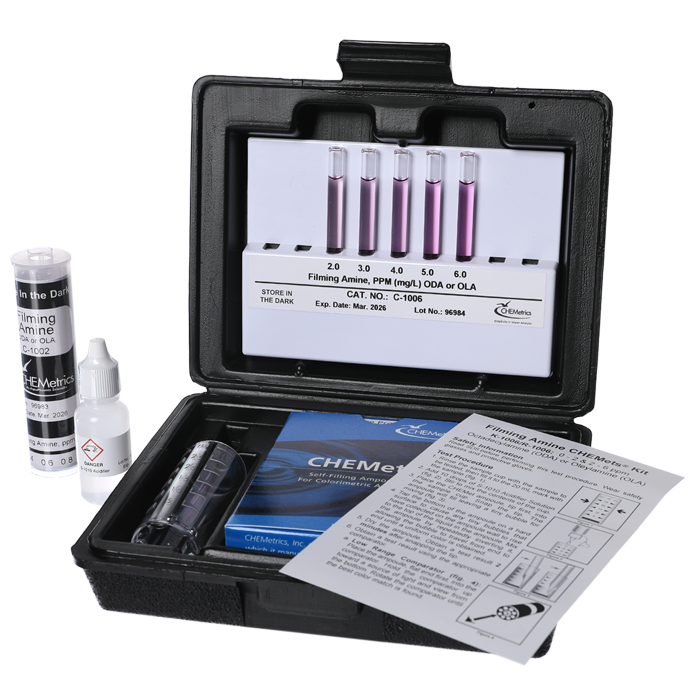
A) In most cases, 30 tests can be performed with each CHEMetrics kit. Detergents, filming (aliphatic) amines, and FoalWatch® kits contain 20 tests. Sulfite in wine kits contain 10 tests. The TPH refill contains 16 tests. Most ampoule refill packs contain the same number of tests as the kit.


If a particular test procedure requires one or more accessory solutions to be employed in addition to the vacuum sealed ampoule, then 1 bottle of each accessory solution is provided in the test kit. The bottle(s) of accessory solution which are provided will allow for 30 to 90 tests to be performed (the equivalent of 1 to 3 ampoule refills). Additional accessory solution may be purchased, if needed. Accessory Solution Packs generally contain 6 additional bottles of a particular accessory solution (enough solution to perform approximately 200 additional tests).


Range:


Q) What test range do I need for my application?


A) Because CHEMetrics' test kits are designed for use in a variety of industries, the ideal test range for a particular application may not be known. However, CHEMetrics' Technical Services staff can make a recommendation in many cases.


Q) How is it that some CHEMetrics kits offer 2 ranges (e.g., 0-1 and 1-10 ppm)?


A) A dual range kit contains 2 separate color comparators (low and high range). When a test is performed, the analyst will use either or both comparators to obtain the test result. No sample dilution or test repetition is required.


Q) What if I need to test outside of the range of CHEMetrics’ test kits?


A) The range of many of CHEMetrics’ test kits can be extended by performing dilutions as discussed under the “Dilutions” heading. For lower range testing see the “Custom tests” section. While the ranges of many of CHEMetrics’ test kits are based on industry demand, some are restricted due to the limitations of the test method or available technology.


Sample Color:


Q) My sample is colored. Can I use CHEMetrics' test kits?


A) Slightly turbid or colored samples can be analysed using the instrumental test kits. Visual test kits can sometimes be used, especially when analyte concentration approaches the high end of the test range.


Also see the “Dilutions” heading.


Sample pH:


Q) In order to use CHEMetrics' test kits, what pH does my sample need to be?


A) A general rule of thumb for colorimetric testing is that sample pH should be between 4 and 8.


Sample Volume:


Q) How much sample do I need to conduct the test?


A) In most cases we recommend that the user have at least 25 mL of sample for Vacu-vials, CHEMets, ULR CHEMets, and Titrets kits. Smaller volumes are needed for VACUettes kits.


Shelf Life:


Q) What are the shelf lives of CHEMetrics' products?


A) The CHEMetrics water analysis product line employs vacuum packaging to ensure the longest possible shelf life. It is recommended that all CHEMetrics products  be stored in the dark and at room temperature (exceptions noted in table below) when not in use. Only the CHEMetrics products listed below have (or contain a component that has) a shelf life of less than 20 months.

Catalog No.

Product Description

Shelf Life

A-0175

pH Singles Assortment, 4.01, 7.00 & 10.00

3 months

A-0177

Conductivity/TDS Singles, 447 µs

3 months

A-0178

Conductivity/TDS Singles, 1413 µs

3 months

A-0180

Turbidity Calibration Set

6 months

A-1400

Ammonia Activator Accessory Solution

8 months

A-1700

Calcium Indicator Solution

8 months

A-2700

Chlorine Dioxide Neutralizer Solution

8 months

A-3801

Cyanide Activator Solution

8 months

A-4404

Glycol Activator Solution

12 months

2A-7301

COD Standard Pack, 1,000 ppm

8 months

2A-7310

COD Standard Pack, 10,000 ppm

8 months

C-6502

Manganese Comparator

12 months

C-6502D

Manganese Comparator

12 months

I-2005

Chlorine Dioxide, Single Analyte Photometer

8 months

I-2017

Detergents, Single Analyte Photometer

8 months

K-1403

Ammonia Vacu-vials® Kit

8 months

K-1410

Ammonia CHEMets® Kit

8 months

1K-1503

Ammonia  Vacu-vials® Kit

2 months

1K-1523

Ammonia  Vacu-vials® Kit

2 months

1K-1510

Ammonia CHEMets® Kit

5 months

1K-1510A

Ammonia VACUettes® Kit

5 months

1K-1510B

Ammonia VACUettes® Kit

5 months

1K-1510C

Ammonia VACUettes® Kit

5 months

1K-1510D

Ammonia VACUettes® Kit

5 months

K-1700

FoalWatch Titrets® Kit

8 months

K-1705

Calcium Hardness Titrets® Kit

8 months

K-1710

Calcium Hardness Titrets® Kit

8 months

K-2002

Chloride Titrets® Kit

6 months

K-2703

Chlorine Dioxide Vacu-vials® Kit

8 months

K-2705

Chlorine Dioxide CHEMets® Kit

8 months

K-3803

Cyanide Vacu-vials® Kit

8 months

K-3810

Cyanide CHEMets® Kit

8 months

K-4203

Formaldehyde Vacu-vials® Kit

5 months

K-4605

Formaldehyde CHEMets® Kit

5 months

K-4605A

Formaldehyde VACUettes® Kit

5 months

K-4605B

Formaldehyde VACUettes® Kit

5 months

K-4605C

Formaldehyde VACUettes® Kit

5 months

K-4605D

Formaldehyde VACUettes® Kit

5 months

K-4403

Glycol Vacu-vials® Kit

5 months

K-4423

Glycol Vacu-vials® Kit

5 months

K-4815

Glycol CHEMets® Kit

5 months

K-4815C

Glycol VACUettes® Kit

5 months

K-6502

Manganese CHEMets® Kit

12 months

K-6502D

Manganese VACUettes® Kit

12 months

K-6903

Nitrate Vacu-vials® Kit

12 months

K-6905

Nitrate CHEMets® Kit

12 months

K-6913

Nitrate 4 Vacu-vials® Kit

12 months

K-6923

Nitrate 2 Vacu-vials® Kit

12 months

K-6933

Nitrate 3 Vacu-vials® Kit

12 months

K-7003

Nitrite Vacu-vials® Kit

12 months

K-7413

Ozone Vacu-vials® Kit

6 months

K-7340S

ULR COD Vials

18 months

K-7463

Ozone 3 Trace Vacu-vials® Kit

6 months

K-7518

Dissolved Oxygen CHEMets® Kit

12 months

K-7553

Oxygen 3 Vacu-vials® Kit

12 months

1K-9010

Silica CHEMets® Kit

11 months

1K-9011

Silica ULR CHEMets® Kit

2 months

K-9400

Detergents Kit

8 months

K-9404

Detergents CHEMets® Kit

8 months

K-9903

Zinc Vacu-vials® Kit

8 months

K-9923

Zinc Vacu-vials® Kit

8 months

1R-1501

Ammonia CHEMets® Refill

5 months

1R-1501A

Ammonia VACUettes® Refill

5 months

1R-1501B

Ammonia VACUettes® Refill

5 months

1R-1501C

Ammonia VACUettes® Refill

5 months

1R-1501D

Ammonia VACUettes® Refill

5 months

R-4605

Formaldehyde CHEMets® Refill

5 months

R-4605A

Formaldehyde VACUettes® Refill

5 months

R-4605B

Formaldehyde VACUettes® Refill

5 months

R-4605C

Formaldehyde VACUettes® Refill

5 months

R-4605D

Formaldehyde VACUettes® Refill

5 months

R-4815

Glycol CHEMets® Refill

5 months

R-4815C

Glycol VACUettes® Refill

5 months

R-6905

Nitrate CHEMets® Refill

12 months

R-7518

Dissolved Oxygen CHEMets® Refill

12 months

1R-9010

Silica CHEMets® Refill

11 months

1R-9011

Silica ULR CHEMets® Refill

2 months

R-9400

Detergents Refill

8 months

R-9404

Detergents CHEMets® Refill

8 months

R-9423

Detergents Refill

8 months

1The shelf life for this product can be extended if the short-shelf life component is refrigerated whenever it is not in use.

2Store under refrigeration: 2°C - 8°C (36°F - 46°F).

 
Soil Analysis:
 
Q) Can I use CHEMetrics' kits to analyse soils?

A) The RemediAid (TPH) Starter Kit is designed for soil. Although nearly all of the remainder of CHEMetrics' test kits are designed specifically for water analysis, it is sometimes possible to extract, digest, or distill soil samples for analysis with our kits. Soil analysis test procedures are not currently included with the kits. Contact CHEMetrics' Technical Services Department for information on soil analysis methods and references.

Standards:


Q) Does CHEMetrics offer standard solutions so that I can confirm/document the analytical performance of the test kit?


A) CHEMetrics currently offers standards for COD only. Standards can be obtained from a variety of sources, including Fisher Scientific (phone:800-766-7000
) or Labchem (phone:412-826-5230). A detergent standard can be obtained from Ricca Chemical Company (phone: 817-461-5601).


Titret Usage:


Q) After drawing the initial aliquot of sample into the Titret, I am unable to get the Titret to draw any more sample.


A) Titrets are vacuumed sealed and use the vacuum to draw sample into the ampoule, therefore, if the vacuum is lost, sample will not be drawn into the ampoule. The valve assembly should be firmly seated at the reference line and not removed once the ampoule has been snapped.  Also, it is important that pressure be applied to the bead valve ONLY when the valve assembly tip is submerged in the sample.


Q) What if my Titret fills all the way and I do not see a color change? What if I see an immediate color change?


A) Titrets are based on a "reverse titration". If the titret fills completely and the endpoint is not reached (no color change) then the sample concentration is below the range of the kit. (Not enough analyte was added to reach the equivalence point of the titration and effect a color change). If an immediate color change occurs, the sample concentration is above the range of the kit.