

Authored by Zachary Waszczak
After nearly eleven months of caring for your pregnant mare, she is getting ready to foal! Congratulations! This is an exciting time, but it can also be stressful! Here are some tips on predicting foaling and how CHEMetrics FoalWatch™ test kits can help make your foaling season easier.
What is Foaling?
Foaling is the process of a mare giving birth to her baby horse or foal. Like giving birth for most mammals, there can be complications that could endanger the mother and child. An average pregnancy for a horse is around 340 days, so reaching the foaling stage takes nearly a year. Roughly 2-3 weeks before delivery most caretakers begin preparing a space for the mare to give birth and ensuring the essentials are prepared for the upcoming foaling.
The Stages of Foaling
Once the foaling process starts, it follows three distinct stages.
Stage One of Foaling: Stress and Contractions
Stage one is characterized by the start of contractions and the mare showing signs of stress. The mare may start circling, sweating, urinating, defecating, and beginning to drip milk. It is easy to miss the beginning of this stage as the signs may not be obvious. As the stage continues, the stressed behavior becomes more apparent. Monitor the mare, but try not to cause her stress as mares can delay the next stage of foaling until they feel more comfortable.
Stage Two of Foaling: Delivery
Stage two begins once the mare’s water breaks. The mare is typically lying down by this stage and ready to give birth. This step is typically the fastest and can be finished in under half an hour. In a normal birth you will see the foal’s front hooves begin to emerge from the mare. Further contractions will move the foal through the birth canal. If there are no complications, the mare can give birth on her own. If any complications do arise, veterinarian assistance will be needed.
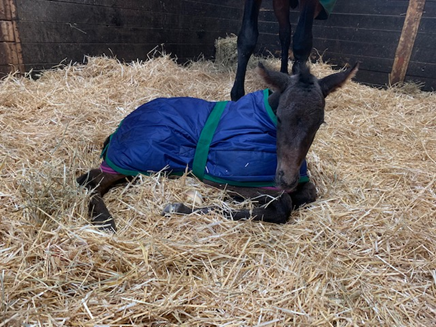
Stage 3 of Foaling: Expulsion of the Placenta
The final stage of foaling is the expulsion of the placenta. This usually occurs within three hours after birth. Do not pull the placenta out as it may cause serious harm to the mare. If the placenta is retained for too long, a veterinarian will need to be called to prevent infection.
What Does It Mean to Be on a Foal Watch?
To be present during the birth and handle any complications that may arise, most owners enter a phase affectionately referred to as a “foal watch”. A foal watch starts roughly two weeks before the mare is due to give birth. During a foal watch, owners will monitor their horse closely keeping an eye on details like food consumption, urination, body changes, and if they start producing milk. All of these can be signs that the mare is about to give birth.
Ways to Predict Foaling
Being on foal watch can be stressful. Owners may be checking on their mare hourly and keeping a log of details. Every horse owner will have their own method of handling this time. Some owners will book their mares a stay at a location where they are monitored by staff. Others may install expensive cameras into their barn to maintain a close eye. Some may go the old-fashioned route and sleep right in the barn! Predicting when foaling will begin is the dream of anyone who has endured a foal watch. There are a few tools people use to predict when foaling will occur.
Gestation Calendar
A gestation calendar is often used to predict foaling but this requires knowledge of the exact date the mare was bred and only provides a window that can be several weeks long. It is more useful as a guideline for when you should expect the foaling season than the actual date of birth. It is not a replacement for a foaling test which can more accurately predict foaling.
Labor Alert Devices
Labor alert devices are monitoring devices that are attached to the mare’s body. The devices vary in method, but they all monitor physical aspects of the mare and provide alerts when a metric is crossed that indicates an incoming birth. These devices can be unwieldly and expensive but are useful if you are monitoring multiple mares at the same time.
Measuring pH
pH strips have become a popular foaling test. The pH of a mare’s milk often drops the day before foaling. The pH is typically 7.0-7.4 and drops to 6.4 or less 24 hours before foaling occurs. While this metric is useful, pH test strips often lack accuracy and according to many readers of the Equine Chronicle, are best used alongside CHEMetrics FoalWatch™ Test Kits.
CHEMetrics K-1700 FoalWatch™ Test Kit
The most reliable method for predicting foaling in a mare is with a test that measures the calcium carbonate (CaCO3) concentration in the mare’s milk or colostrum. The calcium carbonate levels increase as the foaling date approaches with 50% of mares foaling within 24 hours once the concentration is above 200 ppm CaCO3. The CHEMetrics FoalWatch™ Test Kit uses a reliable proven chemistry to measure the calcium carbonate levels and show results between 50-350 ppm CaCO3, making it one of the most reliable foaling tests available.
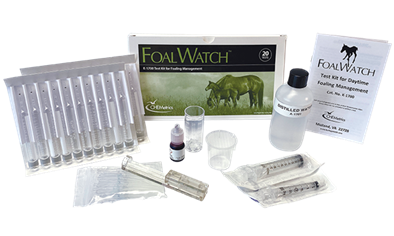
The FoalWatch™ test kit uses a vacuum-sealed glass ampoule called Titrets that are used to draw the sample in small aliquots. This is done until the ampoule changes from orange to blue. Reading your results is as simple as standing the ampoule on its end and reading the concentration printed on the side of the ampoule. The test requires no special training and a video tutorial is available as well.
Testing should begin 10-14 days before the mare’s expected foaling date. If the breeding date is unknown, begin testing when the mare has udder enlargement and udder secretions can be obtained without excessive effort. Once the calcium concentration is regularly above 100 ppm, test once in the morning and once in the evening. When you get your first reading at 200 ppm CaCO3, the mare will likely give birth in 24 hours. Birth before a reading of 200 ppm CaCO3 is very unlikely.
The Foal Watch test kit comes with everything needed for 20 tests and is available on the AquaPhoenix website.